Journal
The natural stone coffee table: a guide to choosing well
·The Pietra team
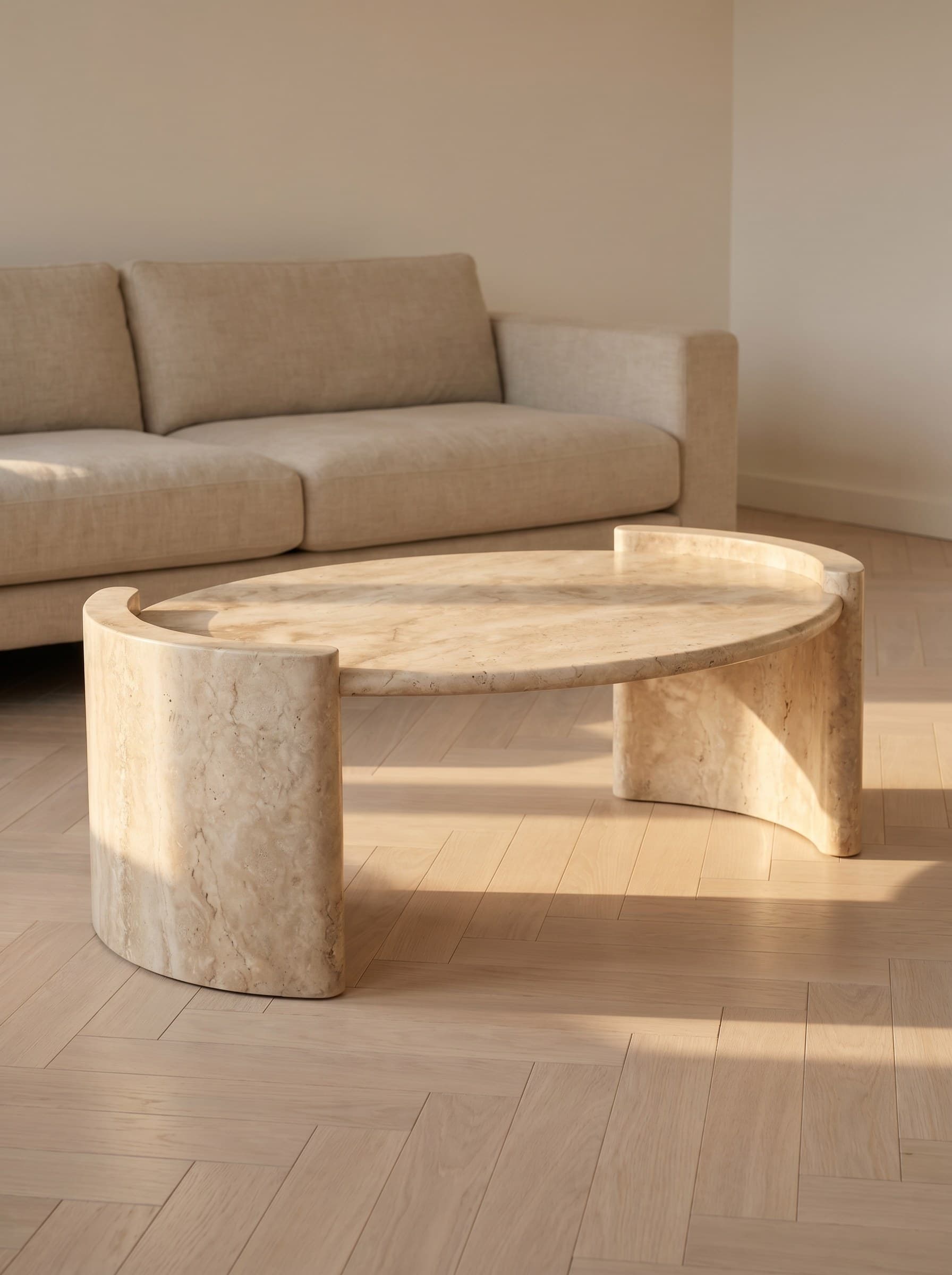
The coffee table is the piece of furniture with the most decisions per square centimetre. It occupies the exact centre of a living room’s life: it takes the books, the glasses, the feet and the glances. When it is also natural stone (a material you do not swap with the seasons), it pays to decide well the first time.
This guide gathers what we explain to every client before carving: sizes that work, which shape each room asks for, what role the base plays, and what living with a hundred kilos of travertine actually means. No magic formulas; just rules that have worked for decades.
Size: three rules that do not fail
Before falling for a piece, measure the sofa. The table is chosen from it:
- Length: about two thirds of the sofa’s length. For a 220 cm sofa, a 130–150 cm table or a Ø90–100 cm round.
- Height: level with the sofa seat, or 2–5 cm below it. With seats at 40–45 cm, tables of 32–35 cm, the natural height of stone, work beautifully.
- Clearances: 40–45 cm between sofa and table (legs pass, coffee stays within reach) and 75–90 cm of free passage on the main walkways.
And a golden rule for stone: when in doubt, go slightly smaller. A travertine volume has more visual presence than a lightweight piece of the same dimensions; the stone supplies the emphasis on its own.
Round, oval or rectangular
Round: the friendliest form, and the one stone understands best. No corners at shin height (ideal with children), fluid to walk around, and perfect for L-shaped sofas and circular conversation. In a mid-sized room, a Ø85–95 cm round is hard to beat.
Oval: the answer when the sofa is long but the passage is tight. It covers surface like a rectangle and circulates like a round. It is the most elegant shape in long rooms, and its carving, one continuous ellipse in stone, shows the artisan’s hand like little else.
Rectangular: the most capable. It maximises usable surface, brings order to large rooms and sits in calm parallel with a straight three-seater. It asks for air around it: in tight rooms, its corners make themselves known.
The base: what supports also draws
On a stone table, the base defines character as much as the top. The cylinder or block base, our favourite, creates that monolithic, serene silhouette that made travertine tables iconic; visually it is kin to the atelier’s pedestals, and it allows beautiful duets between pieces. Twin separated supports lighten long tables and let light pass beneath the top. And the single-block top with no distinct base is absolute minimalism: one stone, one veining, nothing to explain.
A practical rule: the bolder the veining, the calmer the form should be, and vice versa.
Which sofa it lives best with
Almost any: that is the advantage of a mineral material in cream tones. With linen or cotton sofas in naturals and sands, travertine builds that warm tone-on-tone of quiet luxury. With cognac or chocolate leather, pale stone becomes the luminous counterpoint. With deep-coloured sofas (bottle green, midnight blue), a light travertine or a boldly veined marble keeps the composition from going dark. If the room already carries a lot of timber, stone adds the mineral silence that was missing; add a stone side table beside the armchair and the material gains continuity across the room.
Weight: the question everyone asks
A stone coffee table weighs between 75 and 150 kg. The inevitable question: can the floor take it? The short answer: yes. Spread across the table’s footprint, that weight is far less load per square metre than any modern slab is built for: an upright piano or a full bookcase asks considerably more. On wooden floors we recommend thick felt pads under the base; on underfloor heating, no special precautions at all; stone, in fact, loves it.
Weight is also a virtue in disguise: the table never wobbles, never tips, and carries that sense of permanence no lightweight piece achieves. One thing, though: decide its place before delivery: our white-glove team delivers it carefully to your door.
Dressing the table (or not)
A stone table asks for less decoration than habit suggests. The veining is already the motif: let it breathe. The rule of three works well: one large book, one low object, something alive (a branch, not a hotel-lobby flower arrangement), grouped on a third of the top and never dead centre. The materials that converse best with travertine are the honest ones: matte ceramics, old wood, unpolished brass, glass. And every so often, the most elegant gesture of all: nothing whatsoever. Few surfaces in a home carry emptiness with as much dignity as a natural stone top.
Before you commission
The atelier summary: measure the sofa and the walkways; choose the shape the room asks for (round for conversation, oval for flow, rectangular for capacity); decide how much veining you want to look at every day; and do not fear the weight, for it is part of the value. On the material itself, our travertine versus marble comparison helps you decide, and the care guide retires the myth of difficult maintenance.
The rest is choosing the piece. Our natural stone coffee tables are hand-carved to order in 60–90 days, and if your living room asks for another size or another stone, the custom-made service exists for exactly that.
The collection
The stone, in person
Every piece is hand-carved to order, with the unique veining of its block. Start with the coffee tables.