
Journal
Travertine outdoors: porches, terraces and patios
·The Pietra team
Yes. With the right finish and sealing, travertine lives well outdoors, and it performs best in sheltered settings such as a covered porch or terrace. It is a natural stone, porous by nature, so it asks for a little judgment before you leave it in the open. This guide covers when it works, which finish to choose and how to care for it through the year.
Travertine has stood in Mediterranean courtyards and facades for centuries. The difference between a piece that ages with grace and one that suffers comes down to two choices: the surface finish and the steadiness of the sealing.
Does travertine hold up outdoors?
It does, with caveats. Travertine is porous, and those pores absorb water. In climates with frost, trapped water freezes, expands and can cause hairline cracks over time. This is the freeze-thaw cycle, the factor most worth keeping in mind outdoors.
The finish changes the equation a great deal. A honed travertine (matte, smooth) or a tumbled one (soft edges, warm to the touch) opens the pores less than a high polish, and holds sealer better. For outdoor use we always prefer these finishes over a mirror polish, which grows slippery and stains easily outside.
In mild climates without hard frost, sealed travertine sits comfortably on a terrace. In cold climates, the sensible move is to shelter it under cover or bring it in for the harshest months. To understand the stone in full, this look at travertine pros and cons helps you decide.
Indoor vs outdoor at a glance
The same pieces, two different settings. This table sums up what shifts when a travertine table moves from the living room to the terrace.
| Factor | Indoor | Outdoor |
|---|---|---|
| Sealing | Every 18 to 24 months | Every 12 months, sooner in damp spots |
| Finish | Honed or polished | Honed or tumbled, never high polish |
| Climate | Stable, frost-free | Best under cover, bring in for hard frost |
| Maintenance | Soft cloth and neutral pH | More frequent cleaning, dry after rain |
Outdoor care
Outdoor care is straightforward, only more regular than indoors. The key is not to let water sit on the stone or stains rest on the surface.
- Yearly sealing. Renew the penetrating sealer once a year, twice in very humid or coastal climates. The step-by-step is in our guide on how to clean and seal travertine.
- Covered terrace. A porch or pergola cuts direct rain and harsh sun. It is the best home for a travertine piece outside.
- Winter. In frost-prone areas, bring the piece in or cover it and raise it off the ground so water does not pool at the base.
- Stains. Wipe wine, oil or citrus as soon as they land. Unsealed travertine is sensitive to acids.
Pieces for porch and terrace
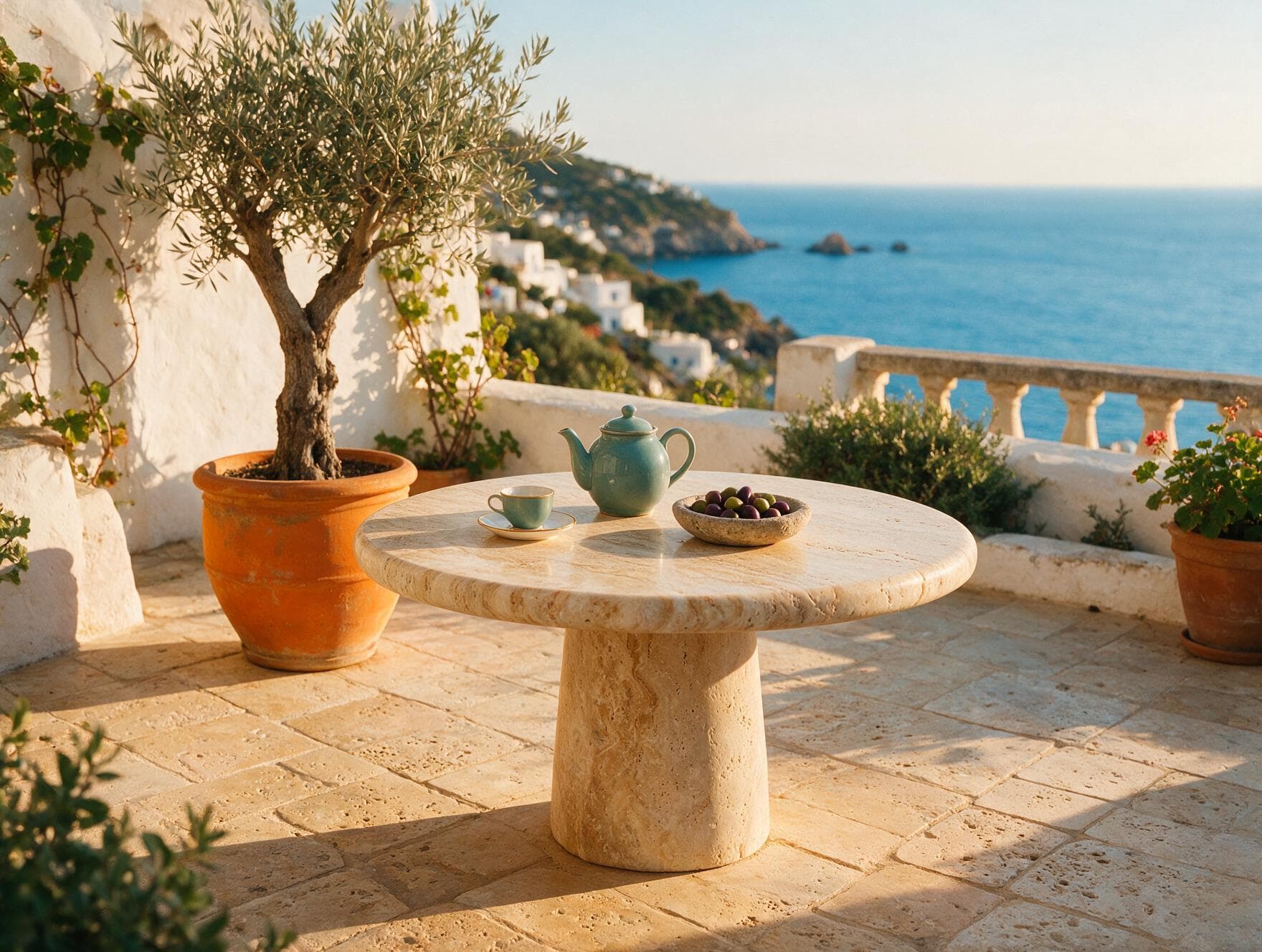
A honed travertine side table is the most versatile piece for a porch: light to move, easy to cover and quiet beside a lounge chair. We carve them by hand and to order, with no two alike.
If you want something designed from the start to live outside, we can adapt the finish, the top thickness and the base to your climate. Tell us about your project on custom-made pieces and we begin with the travertine that fits best. Every commission is hand-carved, with a lead time of 60 to 90 days.
Frequently asked questions
Can travertine be used outside?
Yes. With a honed or tumbled finish and sealing kept up to date, travertine lives well outside. It performs best in sheltered settings, like a covered porch or terrace, where it stays clear of direct rain and the harshest sun.
Does travertine withstand rain and frost?
It handles rain well when sealed and dried after downpours. Frost is more delicate: in the freeze-thaw cycle, water in the pores freezes and can cause hairline cracks. In frost-prone climates, shelter the piece under cover or bring it in for winter.
Which travertine finish is best outdoors?
Honed (matte and smooth) and tumbled (soft edges) are the best for outside. They are less slippery, stain less and hold sealer better. A high polish is not recommended outdoors because it grows slippery and is more prone to staining.
How often to seal outdoor travertine?
Once a year as a rule, and twice a year in very humid or coastal climates. A quality penetrating sealer protects the pores without altering the natural feel of the stone.
Is outdoor travertine slippery?
With a honed or tumbled finish, travertine gives sure footing even when wet. The slippery one is the high polish, which is why we avoid it outdoors. For a travertine floor on a terrace, always choose a matte finish.
The collection
The stone, in person
Every piece is hand-carved to order, with the unique veining of its block. Start with the coffee tables.