
Journal
How to remove stains from travertine
·The Pietra team

To remove a stain from travertine, act fast, blot the liquid without wiping and identify the stain type first. Wiping drags the liquid across the porous surface and widens the mark. The right move is to press a clean cloth or paper towel down to lift whatever the stone has not yet absorbed.
Travertine is a porous limestone. Every vein and pore can hold liquid, so the method depends on what landed on it. A water mark is treated differently from an oil mark, and an acid mark is not really a stain at all, but damage to the polish.
For oil or grease that has already set in, wiping does nothing. The answer is a poultice, an absorbent paste that is left to dry on the stone and pulls the oil up from inside the pore. The full step-by-step method is below. If you want to understand the stone before you treat it, read our guide to travertine pros and cons or explore the world of travertine in our studio.
Stain types and how to act
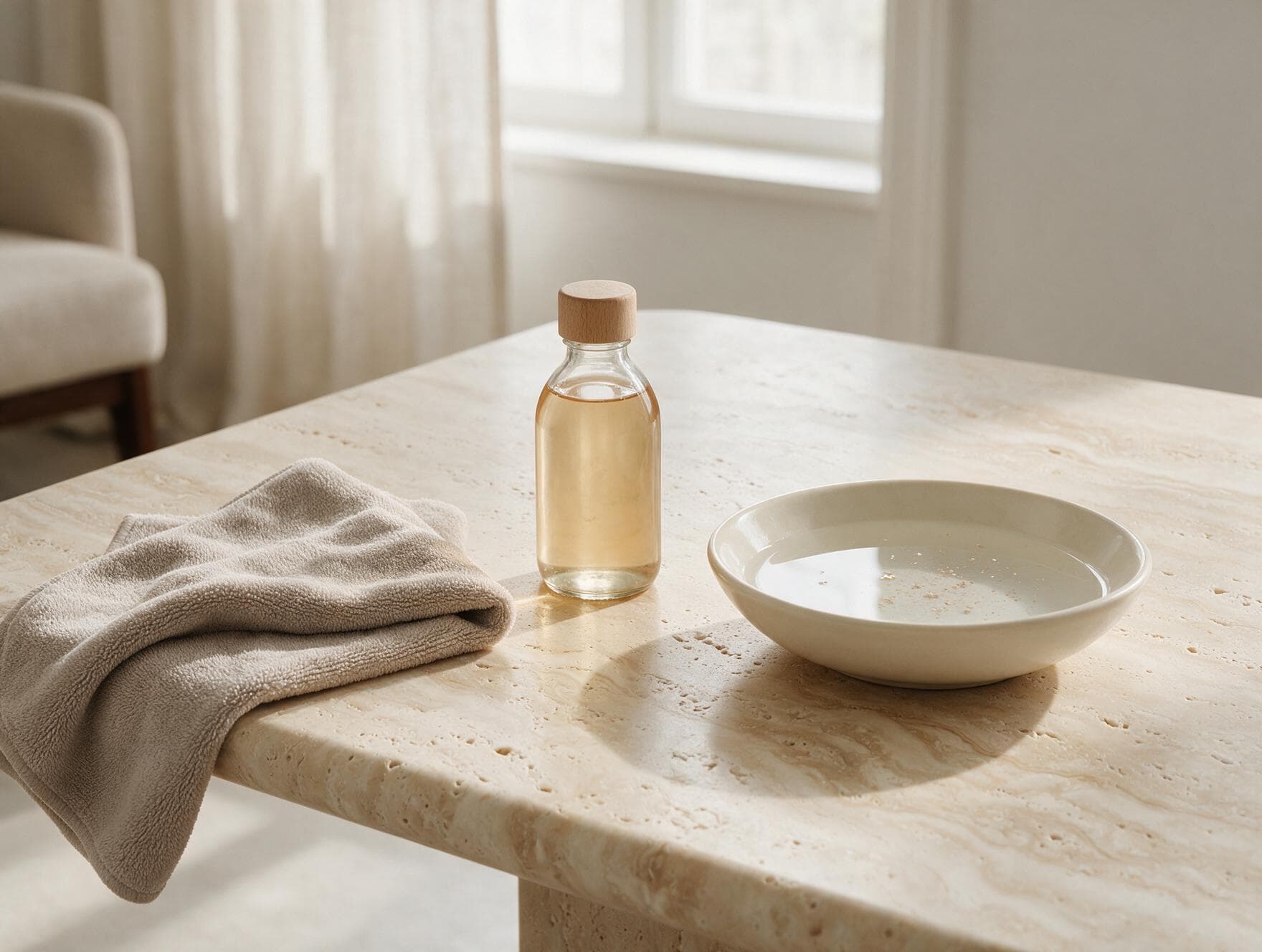
Not every mark is the same. This table sums up the four most common cases on a travertine table or countertop, with the correct first move for each one.
| Stain | How to treat |
|---|---|
| Oil or grease | Blot the excess. Apply a poultice of baking soda and water; let it dry and remove it. Repeat if needed. |
| Wine or coffee | Blot at once. Clean with warm water and pH-neutral soap. For the ring, use a poultice made with hydrogen peroxide. |
| Water ring | Usually surface deep. Dry well and let the stone breathe. If the ring persists, dry-buff with a soft cloth or call a professional. |
| Acid mark (etching) | Not a stain but worn polish. Cleaning will not lift it; it needs spot re-polishing by a specialist. |
The poultice method
The poultice is the most reliable tool for set-in oil and for older rings. It is a paste that, as it dries, reverses the flow and draws the liquid out of the pore toward the surface. Follow these steps without rushing.
- 1.Clean the area with warm water and a pH-neutral soap. Dry it well.
- 2.Make the paste. For oil, mix baking soda with water until it has the texture of soft butter. For wine or coffee, use hydrogen peroxide instead of water.
- 3.Spread a half-centimetre layer over the stain, going slightly past the edges.
- 4.Cover with plastic film and make a few small holes so it dries slowly. Tape down the border.
- 5.Let it work for twenty-four to forty-eight hours, until the paste is dry and hard.
- 6.Lift the dried poultice with a plastic spatula, without scraping the stone.
- 7.Rinse with warm water and dry. If a shadow remains, repeat the process; deep stains can need two or three cycles.
What not to do
Most permanent damage to travertine is caused not by the stain but by the wrong way of removing it. Avoid the following.
- No acids. Vinegar, lemon and descaling products etch the stone and leave a dull mark that cannot be cleaned away.
- No abrasives. Steel wool, scouring powders and stiff sponges scratch the polish.
- No undiluted bleach or ammonia. They dry the stone out and can shift the tone.
- Do not rub a fresh spill. Always blot; rubbing spreads it and pushes it deeper into the pore.
Prevention
The safest way to avoid removing stains is to keep them from setting. Sealed travertine buys you time: liquid sits on the surface for a few minutes before it sinks in, and that is usually enough to blot it in time. Seal the stone once or twice a year with a penetrating sealer for natural stone. Our guide on how to clean and seal travertine explains the process in detail.
- Use coasters and trivets under glasses, cups and hot dishes.
- Wipe up any spill at once, especially oil, wine and citrus.
- Clean daily with nothing more than warm water and pH-neutral soap.
- Reseal when water stops beading on the surface.
A piece for life
Well cared for, travertine ages gracefully and stays with you for decades. Every Pietra by Bianca piece is hand-carved to order, in sixty to ninety days, and arrives with white-glove delivery across Europe. If you dream of a table or a console built to your measure, discover our custom-made service and let us begin to shape it.
Frequently asked questions
How do you remove an oil stain from travertine?
With a poultice. Mix baking soda and water into a thick paste, spread it over the stain, cover it with film and let it dry for twenty-four to forty-eight hours. Lift the dried paste and rinse. The poultice draws the oil up from inside the pore; repeat if a shadow remains.
Can water rings be removed from travertine?
Almost always. Water rings are usually surface deep. Dry the area well, let the stone breathe and dry-buff with a soft cloth. If the ring is old, a poultice made with hydrogen peroxide usually clears it.
What is a stone poultice?
It is an absorbent paste, made with baking soda or hydrogen peroxide, that is applied over the stain and left to dry. As it dries, it reverses the flow of the liquid and draws it out of the stone pore toward the surface, where it is removed with the paste.
Does vinegar clean travertine?
No, and it should never be used. Vinegar is acidic and etches travertine, leaving a permanent dull mark. Always clean with warm water and pH-neutral soap, never with vinegar, lemon or descaling products.
How do you prevent stains on travertine?
Seal the stone once or twice a year, use coasters and trivets, and wipe up spills at once. Sealing slows absorption and gives you time to blot the liquid before it sinks into the pore.
The collection
The stone, in person
Every piece is hand-carved to order, with the unique veining of its block. Start with the coffee tables.