
Journal
Dining table size guide
·The Pietra team·Updated
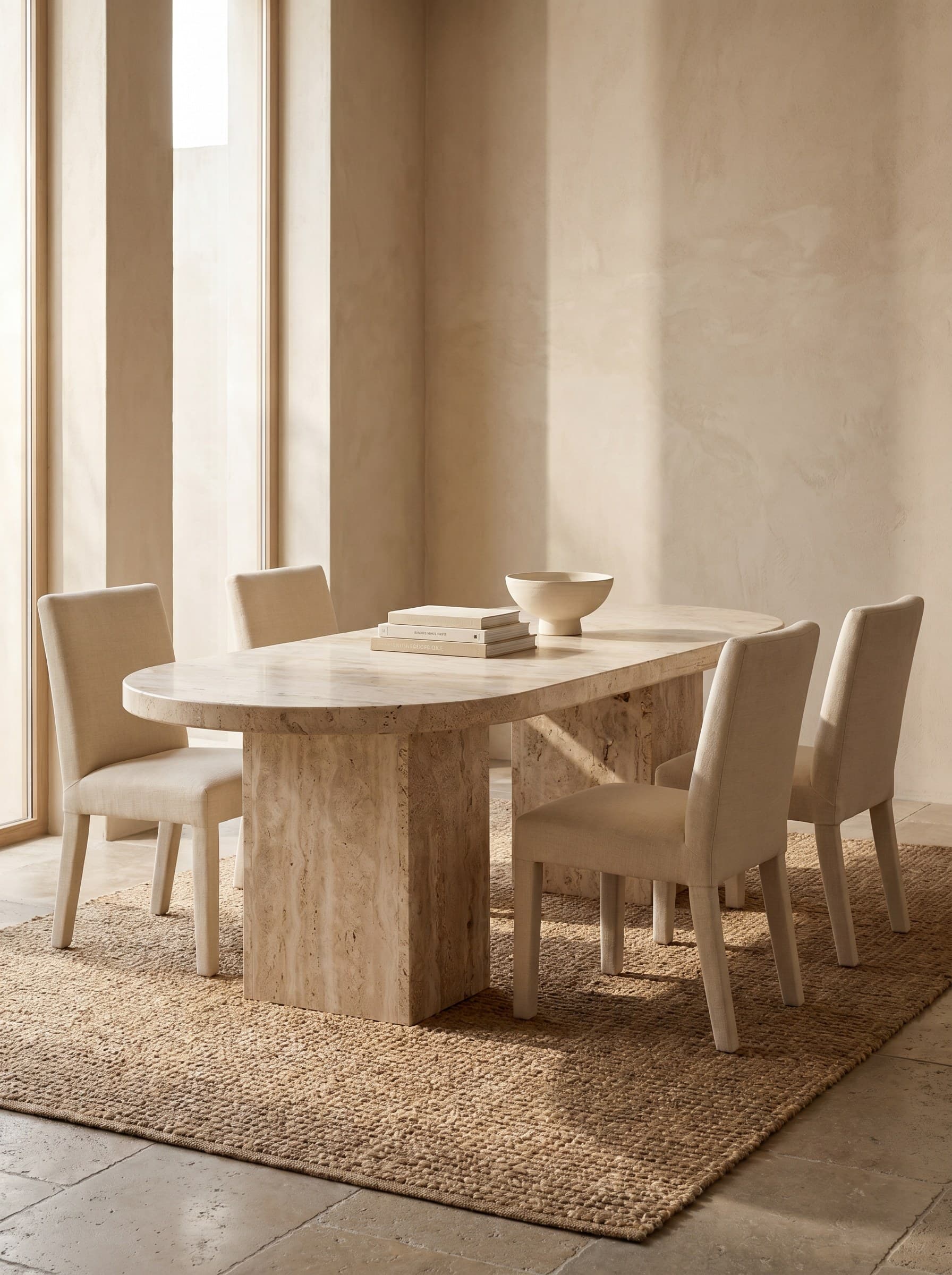
The rule is simple. Allow about 60 cm of table width per diner and leave at least 100 cm of clearance between the table and the nearest wall or piece of furniture. With those two figures, almost any dining room falls into place.
For six people, a rectangular table sits around 180 × 90 cm. A round table that seats six comfortably wants roughly 130 cm in diameter. From there it is all proportion: every diner needs elbow room and plate depth, and every chair needs space to pull back. Below you will find the sizing table by number of diners, the clearance to keep, the standard height, and how everything shifts when the table is made of natural stone.
Size by number of diners
The figures below are a guide and start from about 60 cm of width per person. Shape changes the feel of a table more than you might expect: a long rectangle distributes many diners well, a round one brings faces closer together.
| Diners | Rectangular (cm) | Round Ø (cm) | Oval (cm) |
|---|---|---|---|
| 4 | 120 × 90 | 110 | 140 × 90 |
| 6 | 180 × 90 | 130 | 180 × 100 |
| 8 | 220 × 100 | 150 | 220 × 110 |
| 10 | 280 × 100 | 180 | 280 × 110 |
Clearance around the table
The size of the table is only half the decision. The other half is the air around it. Leave about 100 cm between the edge of the table and the wall or any furniture. That is the distance that lets a chair pull back, a person sit down, and someone pass behind them without brushing past.
Where the route is secondary and no one walks behind the chairs, you can drop to about 75 cm. Below that, the chair meets the wall and the table starts to crowd the room. A practical check: to the width and length of the table, add 200 cm in each direction where diners sit. That is the minimum clear rectangle the room should hold.
- Comfortable passage with chairs occupied: 100 cm.
- Tight passage, no traffic behind: 75 cm.
- Serving zone or sideboard opposite: add its depth, about 45 cm.
Height and shape
A dining table stands about 75 cm tall. Paired with chairs whose seat sits around 45 cm, it leaves the right gap for legs. If you choose benches or armchairs, confirm they clear the apron or the cross rail of the base.
Shape answers the room and the way you like to eat. A round table has no head, favours conversation and moves better in small rooms or narrow passages. A rectangular table yields more per metre and seats many people with ease. An oval is the middle ground: the capacity of a rectangle with softened corners, kinder to walk around. If you are weighing shapes, the same logic applies to smaller pieces. We cover it in our coffee table shape guide.
Rug and lighting
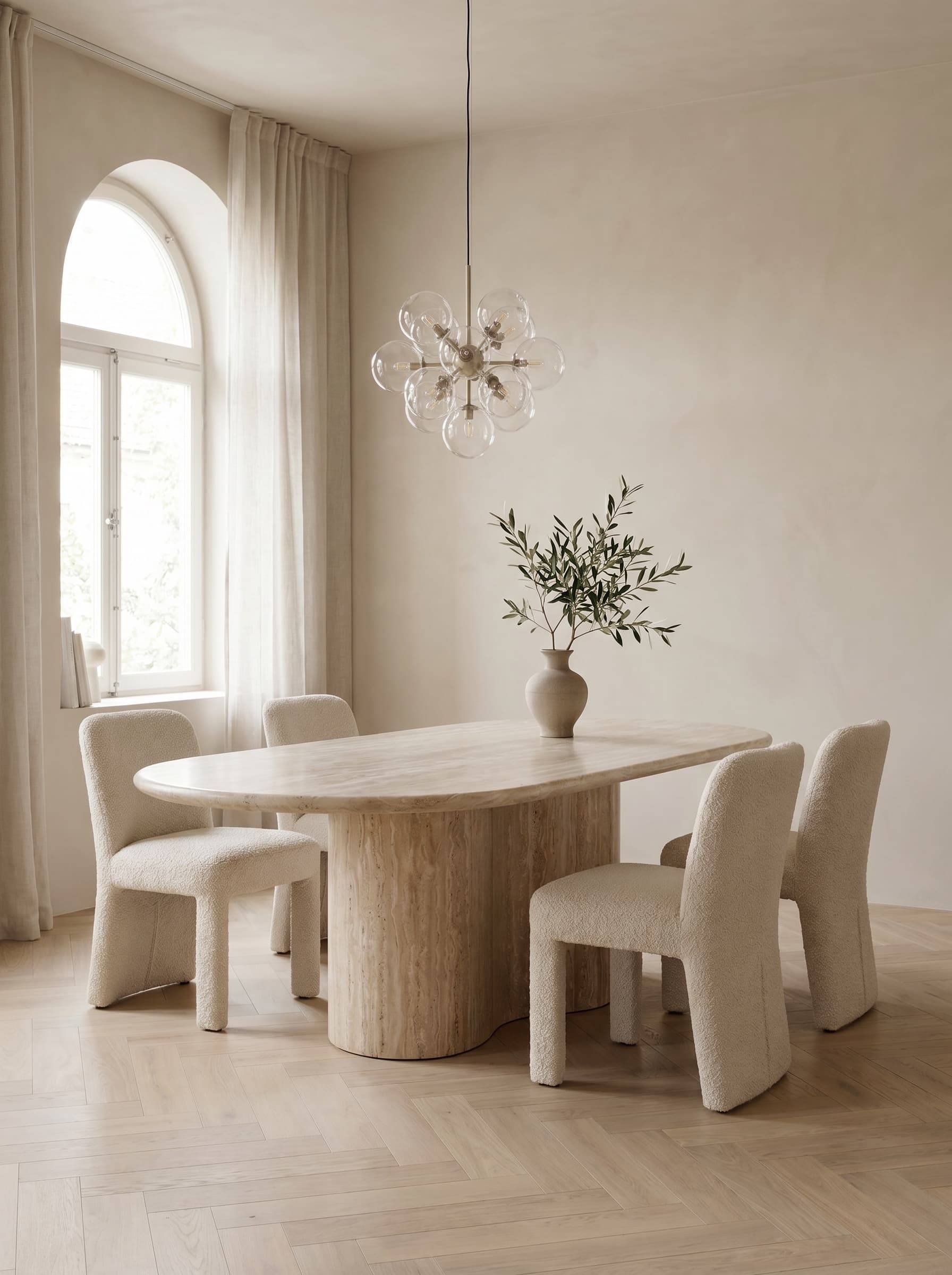
A rug under a dining table should be big enough that the chairs stay on it when pulled back. The rule: it extends at least 60 to 75 cm beyond the table edge on every side where people sit. For a 180 × 90 cm table that means a rug of roughly 300 × 200 cm; for a 220 cm table, about 330 × 240 cm. Too small a rug and the back legs catch the edge every time someone sits down.
A pendant or chandelier hangs about 75 to 85 cm above the table top (a little higher under tall ceilings), so it lights the table without blocking sightlines across it. For width, aim for a fixture about half to two-thirds the width of the table, or roughly the table width minus 30 cm on each side. Over a long rectangular table, two smaller pendants often read better than one large fixture.
And in natural stone
A dining table in travertine or marble is heavy. A 200 cm top can comfortably exceed 150 kg, and that weight shapes two things: the base and the placement.
The base has to spread the load. A central pedestal works for round and oval tops; for long rectangular tops we ask for two supports or a cross rail that prevents sag. That is why it pays to settle the spot before the table arrives: once set, it is not a piece you nudge on your own. Each table is hand-carved to order, over 60 to 90 days, and delivered with white-glove service across Europe. That lets us fit the size to your room to the centimetre, rather than forcing the room into a catalogue size. See the proportions in our dining tables, or tell us about your space for a custom-made piece.
Frequently asked questions
What size dining table seats 6?
For six diners, a rectangular table sits around 180 × 90 cm, a round one wants about 130 cm in diameter, and an oval roughly 180 × 100 cm. The reference is to allow about 60 cm of width per person.
How much space per person at a dining table?
Allow about 60 cm of table width per diner. That is the space that leaves room for elbows, the plate and glasses without crowding a neighbour. On round tables, measure that width along the perimeter.
How much clearance around a dining table?
Leave about 100 cm between the edge of the table and the nearest wall or furniture. That distance lets a chair pull back and a person pass behind. Where no one walks behind, you can drop to about 75 cm.
Round or rectangular dining table?
A round table has no head, favours conversation and suits small rooms. A rectangular table yields more per metre and seats more diners. An oval combines the capacity of one with the softer feel of the other.
What is the standard dining table height?
The standard height is about 75 cm. Paired with chairs whose seat sits around 45 cm, it leaves the right gap for legs. Check that armchairs or benches clear the apron or the base.
What size rug goes under a dining table?
The rug should extend about 60 to 75 cm beyond the table on every side, so chairs stay on it when pulled back. For a 180 × 90 cm table that is roughly a 300 × 200 cm rug; for a 220 cm table, about 330 × 240 cm.
How high should a light hang over a dining table?
Hang a pendant or chandelier about 75 to 85 cm above the table top, a little higher under tall ceilings. For width, choose a fixture about half to two-thirds the width of the table.
The collection
The stone, in person
Every piece is hand-carved to order, with the unique veining of its block. Start with the coffee tables.