Journal
What is travertine? Formation, types, colours and finishes
·The Pietra team
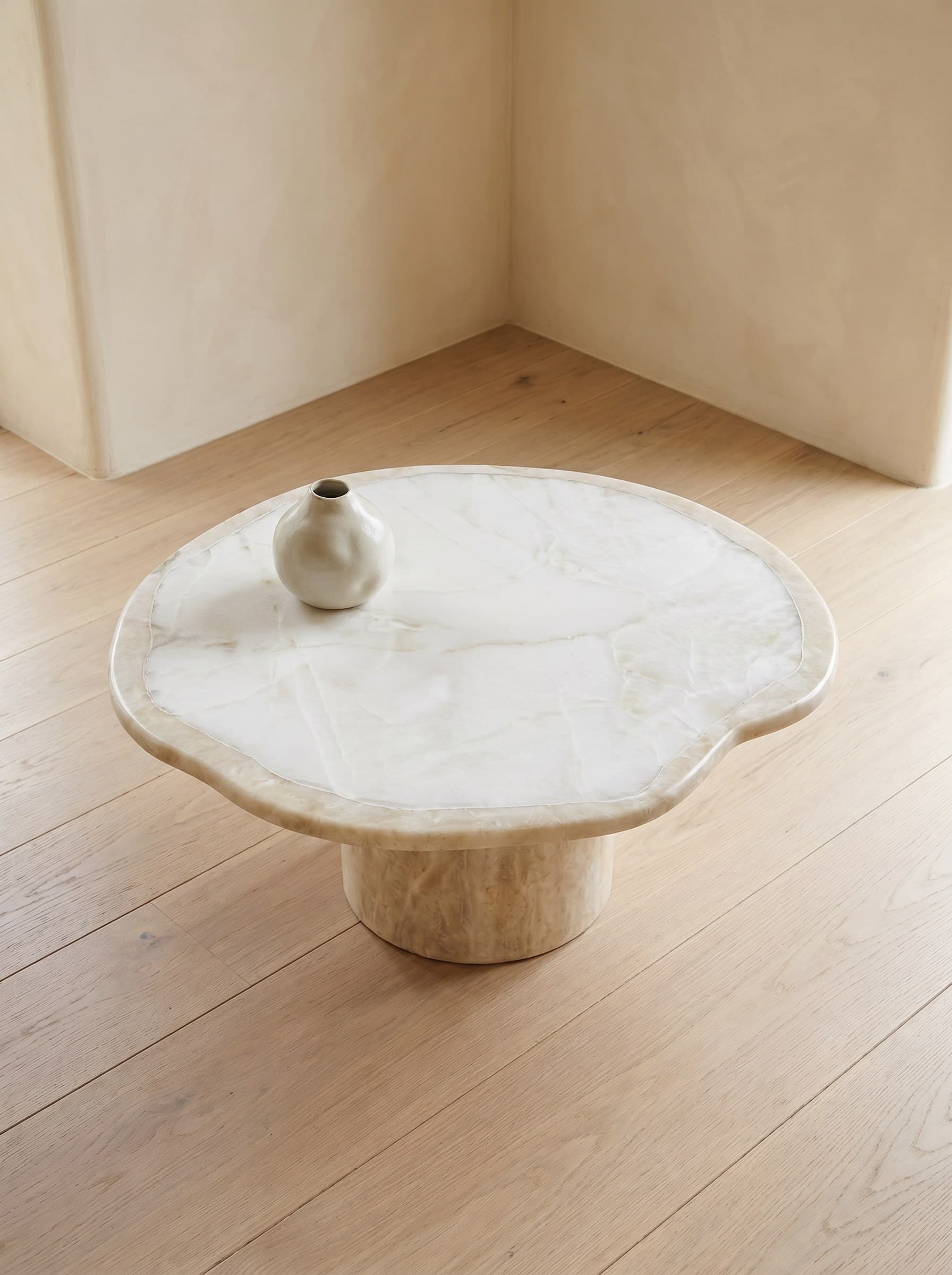
Travertine is stone born of water and time: a limestone that forms as mineral-rich spring water evaporates, layer upon layer, trapping the pores and small voids that make it unmistakable. Almost pure calcium carbonate (calcite), it belongs to the family of limestone and marble without being either. Its warm tones range from cream to walnut.
It belongs to the same mineral family as limestone and marble, but it is neither of them. That distinct identity, warm and porous, is precisely what has made it a reference material for architecture and furniture for more than two thousand years. What follows is how it forms, its types, and everything worth knowing before choosing it for a piece of furniture.
How travertine is formed
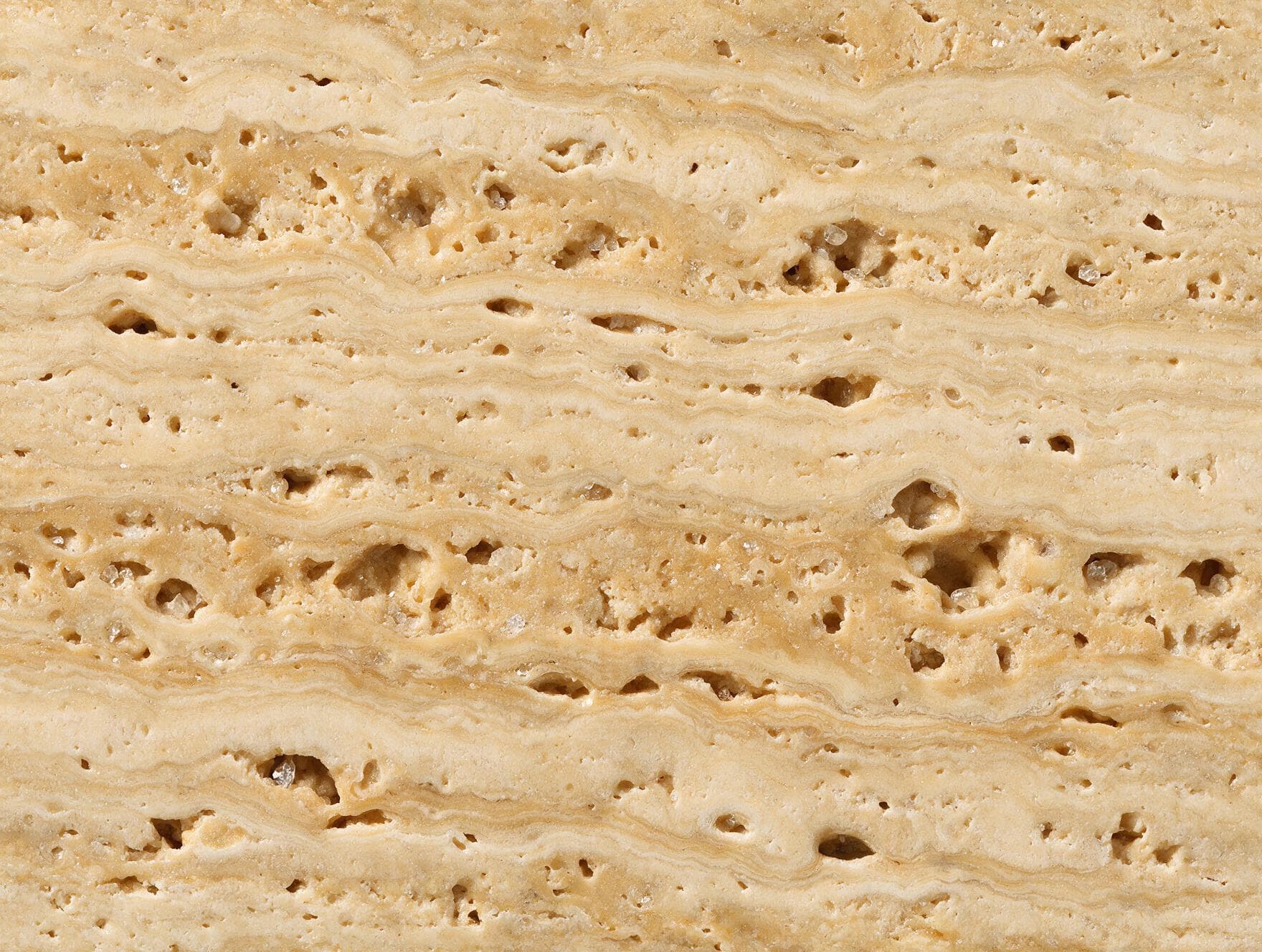
Travertine forms at the surface, not in the depths of the earth. When groundwater rich in calcium carbonate emerges through thermal springs, it releases carbon dioxide and cools on contact with the air. That change makes calcite settle, layer upon layer, around plants, sediment and gas bubbles. The result, accumulated over thousands of years, is a banded, porous rock.
The most celebrated deposit lies near Tivoli, in the Lazio region beside Rome. The name comes from there: the Romans called it lapis tiburtinus, the stone of Tibur (Tivoli), which time turned into travertine. That same stone raised the Colosseum, the Vatican colonnade and much of the Rome we still visit today. Significant deposits also exist in Turkey, Iran and Mexico, yet Italian travertine retains the prestige of the origin.
Types and colours
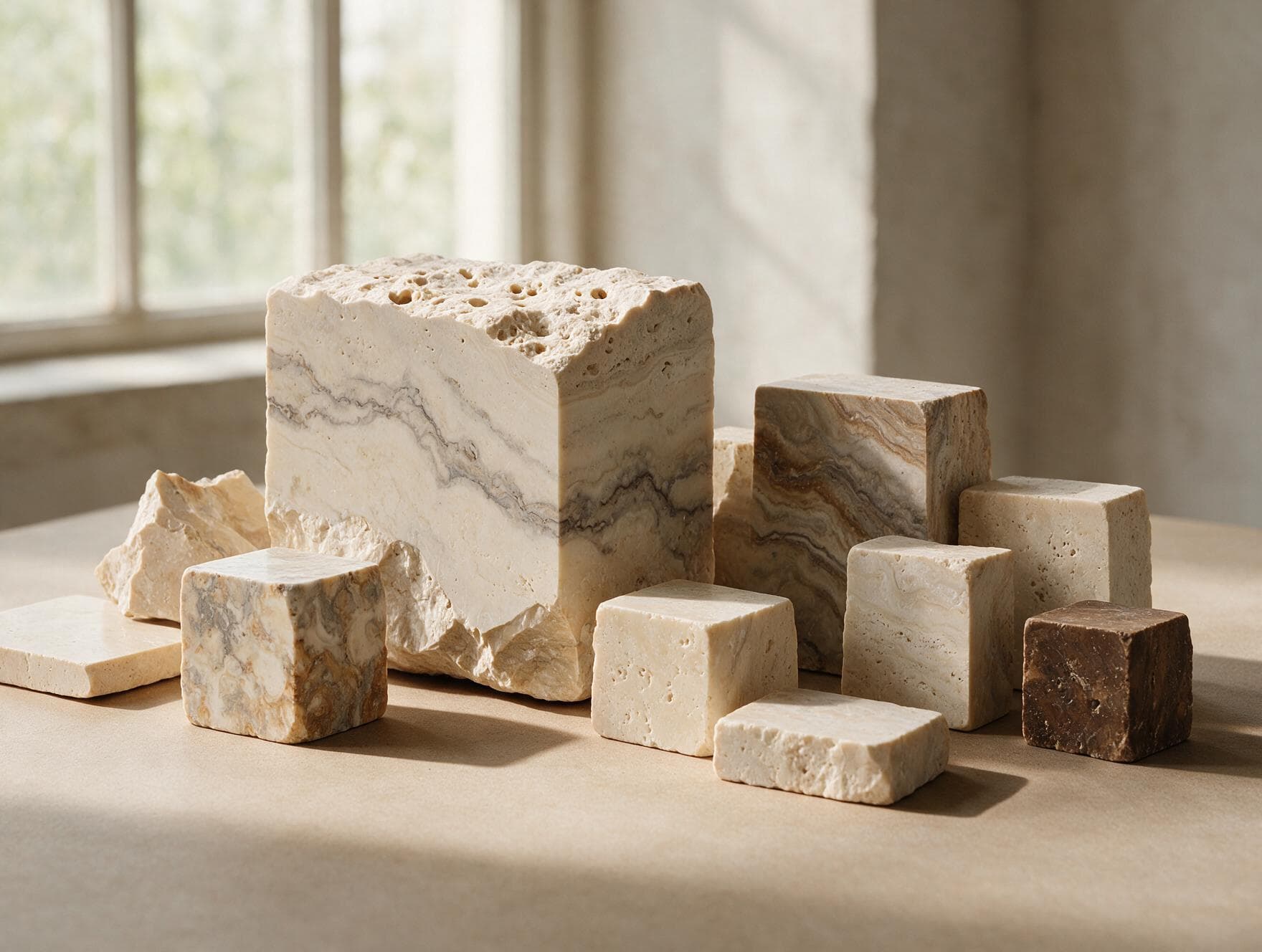
The colour of travertine depends on the minerals present during its formation: iron lends the reddish and golden tones; other oxides, the greys and walnuts. These are the main varieties worked in furniture:
| Type | Colour | Origin / look |
|---|---|---|
| Navona | Ivory cream | The palest and most uniform; fine pores, serene look |
| Romano / Classic | Warm beige | The Tivoli classic; soft banding, highly versatile |
| Silver | Pearl grey | Grey veining over a pale ground; contemporary air |
| Noce / Walnut | Walnut, brown | Chocolate tones; warm and strong in character |
| Red | Reddish terracotta | Iron-rich; the scarcest and most expressive |
Every block is unique: the cut reveals a pattern of veining repeated in no other piece. To go deeper into each variety, its cut and its treatment, see our guide to the types of travertine.
Finishes: honed, tumbled, polished, filled vs unfilled
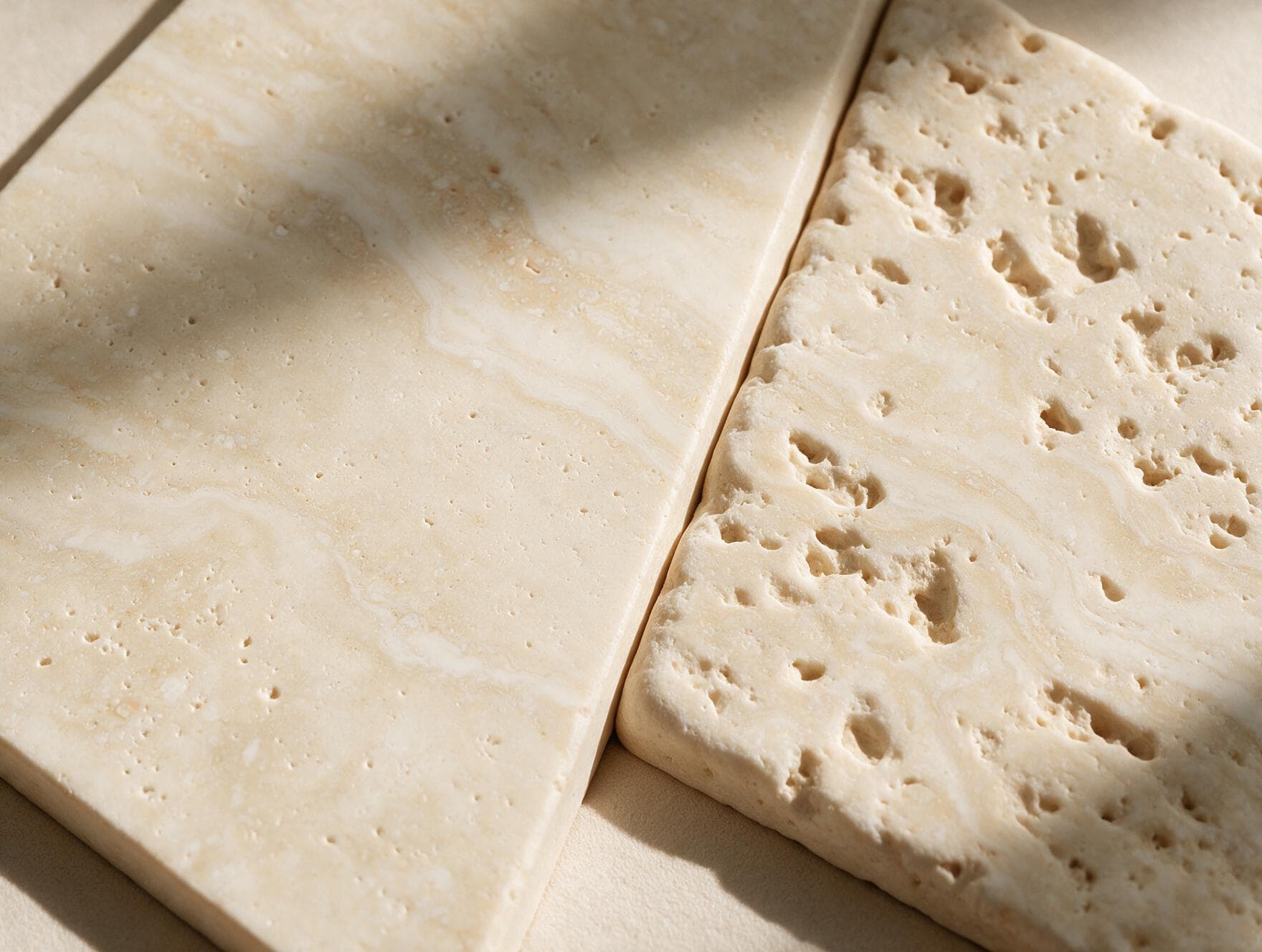
The same stone changes character with its finish. These are the ones worth knowing:
- Honed: sanded to a smooth, matte surface, warm and low-glare. It is the most common finish for furniture and the one we use on our pieces.
- Tumbled: edges and surface softened for a rustic, aged look; seen above all in tiles and pavers.
- Polished: buffed to a satin sheen. Travertine rarely takes the mirror polish of marble: its pores keep it matte-leaning.
- Filled vs unfilled: filled closes the pores with mineral resin for a smooth top; unfilled leaves them open and textural. We fill and hone tables for daily use, and offer visible pores for a rawer look.
Characteristics that matter in furniture
Beyond colour, four properties define how travertine lives in a piece of furniture:
- Porosity: its defining trait. Untreated, it absorbs liquids. That is why it is worked filled (pores closed with mineral filler, smooth surface) or unfilled (pores left visible, more textural), and always with a penetrating sealer that makes it fit for everyday life.
- Hardness: around 3–4 on the Mohs scale, similar to marble. It is a durable stone, though it reacts to acids (lemon, vinegar, wine), which are best avoided.
- Weight: stone is dense. A coffee table can weigh between 75 and 150 kg, which gives it a permanence no lightweight material can match.
- Unique veining: no two pieces are alike. The natural banding is the decorative motif in itself, with no need for ornament.
Travertine vs marble
The question comes up constantly because the two share a calcareous family and centuries of architecture. The difference lies in the origin: travertine is sedimentary and porous; marble is metamorphic, denser and tighter-grained, capable of a mirror polish travertine does not reach. Travertine is warm, matte and textured; marble is cool and sculptural. We develop the full comparison, with price and care, in travertine versus marble: the real differences.
Pros and cons
Like every noble material, travertine has trade-offs, weighed in full in travertine pros and cons. Knowing them is the best way to enjoy it without surprises:
| Pros | Cons |
|---|---|
| Unique warmth and texture | Porous: needs periodic sealing |
| More accessible than marble | Sensitive to acids (etching) |
| Every piece is one of a kind | Heavy in pieces |
| Lasts decades and can be re-honed | Wants neutral soap, not all-purpose |
| Suits almost any style | Visible pores gather some dust |
Uses: from architecture to furniture
For centuries, travertine was above all a building material: facades, columns, floors and cladding on buildings still standing. Today it keeps that role in architecture, and most people still meet it first as tile or flooring, the same stone cut thin. Chosen instead in thick, solid blocks, it has found a second home in designer furniture, where its warmth and veining are enjoyed at hand height.
In the atelier we work it mainly in tables and volumes. Our natural stone coffee tables are its most natural expression: they live at the centre of the living room, at eye height, and thrive on daily use. We also carve it into side tables, pedestals and consoles. To know the stone in depth, the travertine hub gathers pieces and varieties.
Is travertine expensive?
Piece for piece, travertine usually costs less than marble. It is more abundant, quarried at the surface, and somewhat quicker to work. That does not make it a cheap material: a piece, carved by hand, remains an investment. But it offers the presence of natural stone at a more contained price than a boldly veined marble, whose block is priced almost as a one-off work.
How to care for it
Caring for travertine is simple if two rules are kept: no acids, and a sealant renewed on time. Day to day, warm water, a pH-neutral soap and a soft cloth are enough; coasters do the rest. The penetrating sealer is renewed every 12–18 months under normal use. The complete routine, step by step, is in our guide to how to clean and seal travertine.
Travertine is living stone: warm, porous and one of a kind, made to accompany for decades and to age better than almost any other material in the home. Every piece from the atelier is hand-carved to order in 60–90 days, with white-glove delivery across the EU. Explore the collection in the travertine hub, or tell us about your project through our custom-made service: sending photos of real blocks before carving is part of how we work.
Frequently asked questions
Is travertine a real marble?
No. Travertine is a sedimentary calcareous rock and marble is a metamorphic rock. They share the same mineral family (calcium carbonate), but they form differently: travertine precipitates at thermal springs, while marble is born from the recrystallisation of limestone under pressure and heat. That is why travertine is porous and matte, and marble is dense and polishable.
What colour is travertine?
Travertine ranges from ivory cream (Navona) to warm beige (Romano), with pearl-grey (Silver), walnut (Noce) and, more rarely, reddish terracotta varieties. Its colour depends on the minerals present as it forms: iron lends the golden and reddish tones.
What is honed and tumbled travertine?
Honed travertine is sanded to a smooth, matte surface, the most common finish for furniture. Tumbled travertine has softened edges and surface for a rustic look, common in tiles and pavers. Travertine rarely takes a mirror polish the way marble does.
Is travertine expensive?
Piece for piece, travertine usually costs less than marble. It is more abundant, quarried at the surface, and somewhat quicker to work, which lowers the cost. It is not a cheap material, though: a hand-carved piece remains an investment. It simply offers the presence of natural stone at a more contained price than a boldly veined marble.
What are the disadvantages of travertine?
The main ones are porosity, which calls for sealing the stone every 12–18 months, and sensitivity to acids such as lemon or vinegar, which can leave dull marks. Pieces are also heavy, and visible pores gather some dust. With sealing and neutral soap, none of these trade-offs compromise daily use.
What is travertine used for?
In architecture it has been used for centuries in facades, columns, floors and cladding; the Colosseum is the most famous example. In interiors it is used today in designer furniture, above all coffee tables, side tables, pedestals and consoles, where its warmth and natural veining are enjoyed at hand height.
Where does travertine come from?
The most celebrated deposit lies near Tivoli, beside Rome, in the Lazio region; the name comes from there. Significant deposits also exist in Turkey, Iran and Mexico, but Italian travertine retains the prestige of the historic origin.
The collection
The stone, in person
Every piece is hand-carved to order, with the unique veining of its block. Start with the coffee tables.