Journal
How to tell real travertine from an imitation
·The Pietra team
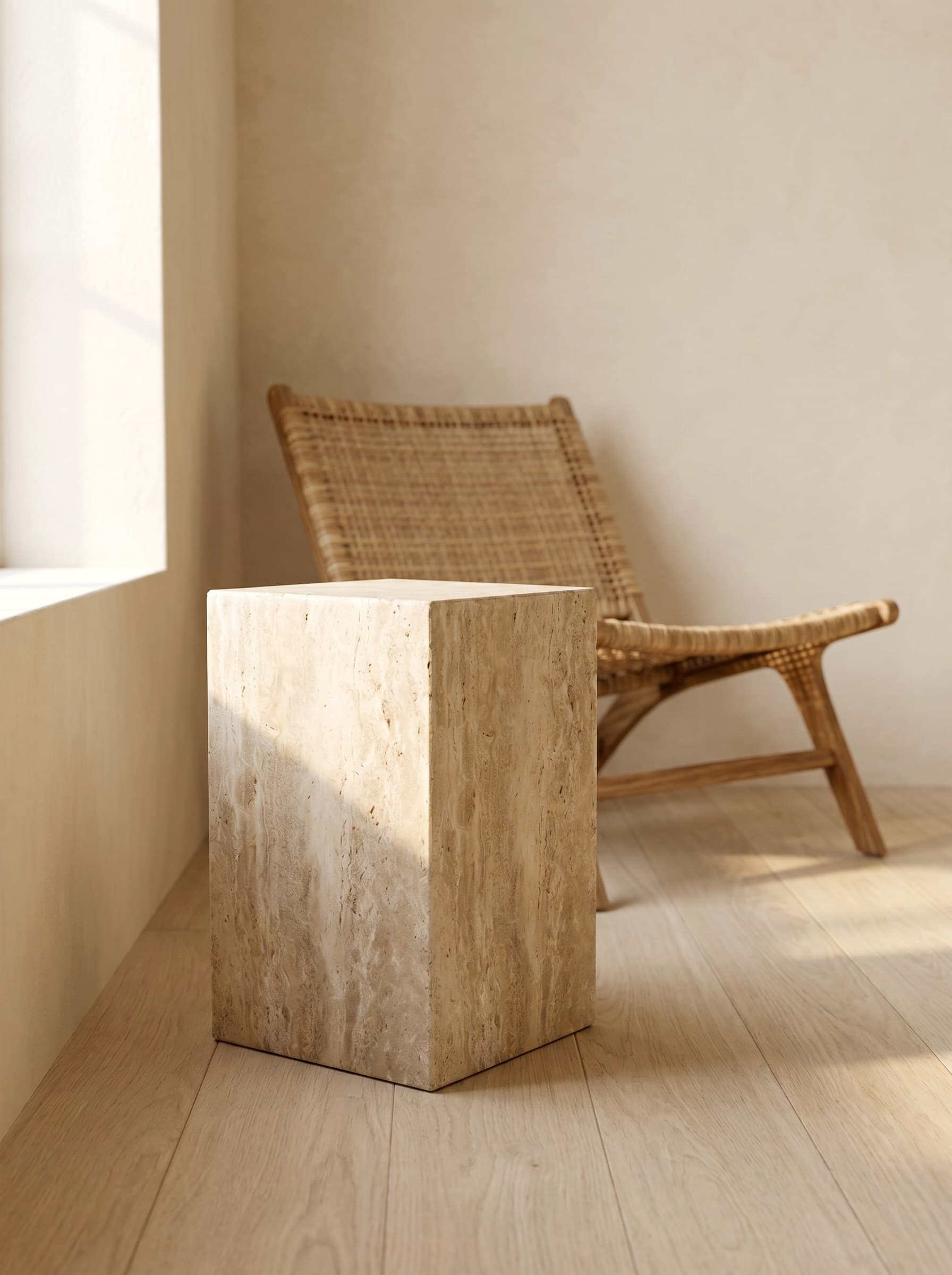
Travertine is having a moment, and with it have come the imitations. Porcelain “travertine-look” tiles, sintered surfaces, resin, laminate, even printed board: in a catalogue photo, many of them fool you. Up close, and over the years, none of them do.
This is a guide to recognising a real piece of travertine, and not taking a copy home, without the jargon: what to look at, touch and check before you buy.
What real travertine is
Travertine is a natural stone: a limestone formed over thousands of years by thermal springs, with real pores and veining that runs through the whole block. It is not a printed material or a composite; it is rock, with its geological memory inside.
An imitation, however good, is something else: a stone pattern printed onto porcelain, sintered stoneware, resin or laminate. The look can come very close; the nature of the material cannot.
Five signs to recognise it
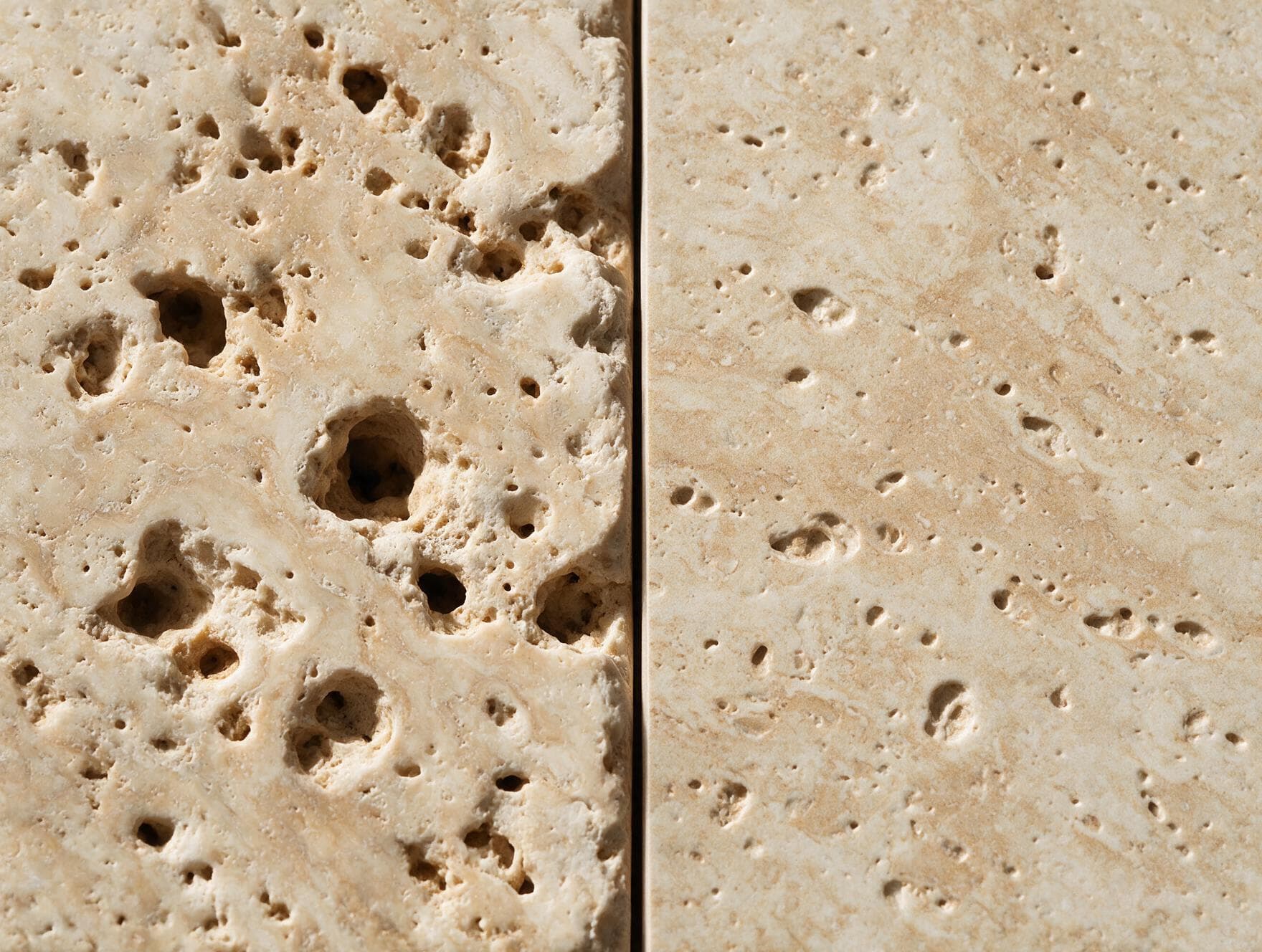
- 1.The pores. Real travertine has open, irregular pores, left open or filled with mineral resin, with real depth. On an imitation, the “pore” is a drawing on a smooth surface.
- 2.The veining. In natural stone the veining runs through the material and never repeats. On a print, the pattern repeats at intervals and lives only on the surface.
- 3.Touch and temperature. Stone is cool, mineral and slightly uneven to the touch. Imitations feel uniform, like plastic or ceramic.
- 4.The edge. Look at the edge: a solid piece shows the same stone through its full thickness. A veneer or laminate reveals a different core at the cut, chipboard, or the body of the porcelain.
- 5.The weight. Solid travertine is heavy, very heavy. If a “stone” table lifts with one hand, it is hollow, veneered or made of a lightweight material.
At a glance
| Feature | Real travertine | Imitation “stone-look” |
|---|---|---|
| Material | Solid natural limestone | Porcelain, resin or laminate |
| Veining | Runs through the block, unique | Printed on the surface, repeats |
| Pores | Real, with depth | Drawn, smooth surface |
| Edge | Same stone through the thickness | Different core at the cut |
| Weight | Considerable | Light |
| Over time | Gains patina, can be re-honed | Scratches and lifts |
Why it matters, beyond looks
The difference is not only one of origin: it is one of future. A well-sealed travertine piece is used every day and ages into more character; if it ever marks, it is re-honed and starts again. An imitation has a short life: once the print wears or the edge lifts, there is no fixing it.
And there is the unrepeatable. Because no block repeats its veining, your piece exists in no other home. That is precisely what cannot be printed.
How we work it in the atelier
In the atelier we always begin with a solid block of travertine, carved by hand and sealed for daily life. On request, we send photographs of the selected block before the first cut: so you know exactly which stone enters your home.
To go deeper, our travertine versus marble comparison and our cleaning and sealing guide answer the most common questions. And our travertine coffee tables are hand-carved to order.
Frequently asked questions
Is filled travertine still natural?
Yes. Filling the pores with mineral resin is a finish, not an imitation: the piece is still solid natural stone, simply with a smoother, more practical surface.
Is porcelain “travertine-look” a bad option?
It is not the same thing. For high-traffic floors it can make sense, but it is not natural stone: the pattern is printed, it does not age the same way and it cannot be re-honed. For a furniture piece meant to last decades, the difference shows.
How do I know if a table is solid or veneered?
Look at the edge and check the weight: a solid piece shows the same stone through its thickness and is genuinely heavy. If in doubt, ask for the thickness and a photo of the cut.
Does travertine stain easily?
Sealed and with basic care, soft cloth, neutral soap, avoiding acids, it is perfectly suited to daily life. It is worth re-sealing every 12–18 months.
The collection
The stone, in person
Every piece is hand-carved to order, with the unique veining of its block. Start with the coffee tables.