
Journal
How to clean and maintain a travertine table
·The Pietra team
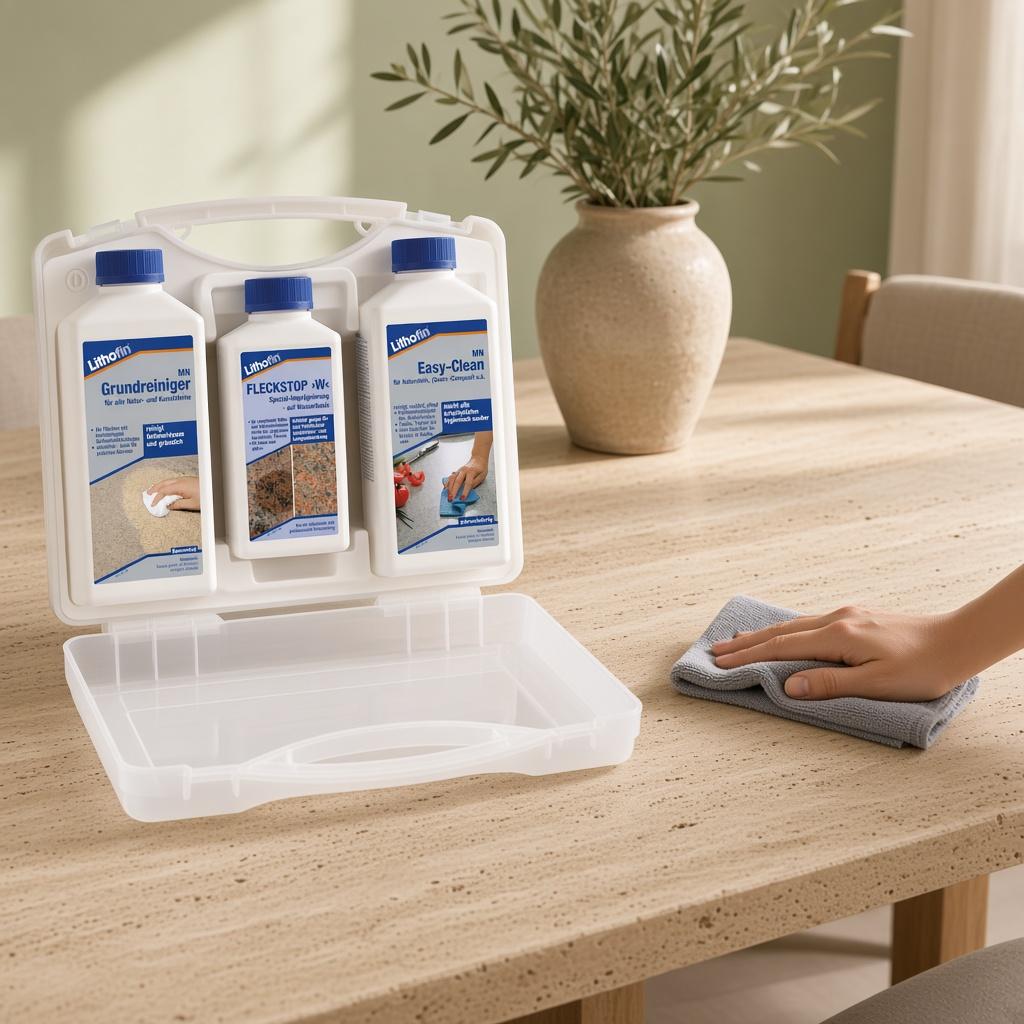
A travertine table is kept with less than people expect, and it is damaged by products that would do nothing on a quartz worktop. Travertine is a limestone: its main component is calcium carbonate, the same thing vinegar attacks. It is porous as well. A spill can go in if the seal is tired.
This guide is the day-to-day of a table, not the technical sheet of a chemical. Doses and hazard statements for a specific kit live on the maker’s bottle. Here we say which gesture is safe and which is not.
What not to use
- Vinegar, lemon and any citrus. They are acids. They leave a dull mark (an attack on the surface) that is not a stain and does not come off by scrubbing.
- Bleach and limescale remover. Too harsh for a calcareous stone. Limescale remover is made to dissolve lime.
- Scouring pads, steel wool and abrasive creams. They scratch a honed face. A microfibre cloth is enough.
- “Bathroom” or “kitchen grease” cleaners whose pH you have not read. If it does not say it is neutral and suitable for marble or travertine, it does not go on the table.
The daily clean
- 1.Take the dust off with a dry, soft cloth. Otherwise the grit becomes sandpaper.
- 2.Wipe with a cloth dampened in warm water and a drop of pH-neutral soap. Do not flood the stone.
- 3.Rinse the cloth and lift the soap. A film of detergent ends up looking like a haze.
- 4.Dry with a second cloth. Water left behind draws rings, especially on travertine.
Sealing, without a magic calendar
Tables from the house leave sealed. Under ordinary use that seal is worth checking every 12–18 months: a drop of water that sits as a bead is still protected; a drop that darkens the stone at once means the impregnator wants renewing. It is not a laboratory rule. It is the test we use in the atelier.
The sealing detail is in the guide to cleaning and sealing travertine. For a stain that has already gone in, go to how to remove stains from marble and travertine. If the table is honed, which is the finish of almost the whole collection, caring for honed and flamed stone explains why it does not behave like a polish.
If you want the kit beside the table
We prepare three products to order, with no stock, dispatched in 5 to 7 business days. The travertine care kit holds Lithofin contents for natural stone. The maintenance kit is Moeller’s HMK M521. The stain remover is FILA SR95, for colour, not for every day. The published price is a guide.
The tables this care belongs with are the coffee tables and the dining tables. The whole category is care and cleaning.
Frequently asked questions
What do I clean a travertine table with?
A soft cloth, warm water and pH-neutral soap. Dry when you finish. Do not use vinegar, lemon, bleach, limescale remover or a scouring pad.
Does the table need sealing?
It leaves sealed. Under ordinary use, check the seal every 12–18 months: if a drop of water darkens the stone at once, the impregnator wants renewing.
Is the kit in stock?
No. We buy it when the order arrives and it leaves in 5 to 7 business days. The price on the page is a guide.
The collection
The stone, in person
Every piece is hand-carved to order, with the unique veining of its block. Start with the coffee tables.